
Print Techniques & Finishes
Print Techniques & Finishes
Every trick in the book
How we make our decks feel special
Below are examples of how we can make your deck of cards look and feel amazing, explained in plain words, with a real example of each. Typically, you can mix and match whatever you like. When you send us your artwork we will advise you what works best.
Part one
The paper
Everything starts with the card stock. We print on black-core European paper, then cut and coat the decks with our award-winning processes. This is the part you feel every time you shuffle.
-

Classic Finish
Included in the base priceOur most popular paper. It feels like a really good Bicycle deck, but smoother, and the edges stay clean instead of going gray when moist. Medium stiffness with a soft, papery feel in the hand.
This is what most people choose for decks that will actually get played with: poker nights, gifts, corporate decks.
Good to knowLasts around three times longer than a Bicycle or Bee deck. Feel it yourself in our sample pack.
-
Viper Finish™
Included in the base priceOur own invention. Super thin (without crushing and damaging the fibers), with a smooth, raised texture (that is where the name comes from). It feels snappy, dry and silky, and it does not go soft in humid weather.
Cardists and magicians love it because it fans and spreads beautifully, with sharp and predictable handling characteristics.Good to knowSlightly shinier than Classic Finish. Thinner and more flexible than Classic, so for a deck that will see heavy poker play we usually suggest Classic instead.
-
ULTRA™ colored core
PremiumNormal card paper is white in the middle, so the side of a deck looks white. Our ULTRA™ process is colored all the way through, so the edges of the whole deck are black, or red, or another color.
Because it is the paper itself and not paint or foil gilding, it never chips or fades, and the deck looks new for years.
Good to knowColored paper is hard to print on, so ULTRA decks are typically made with silver double-sided full foil (below), which gives the ink printed on top a bright and solid surface to sit on. See Stratosphere and Draconian.
-
Tarot & oversized cards
Mid-rangeOur tarot stock is the same casino-grade European black-core paper, available in smooth or with a linen texture, so a tarot or oracle deck shuffles like real playing cards instead of the stiff, cheap cardboard you typically see in tarot decks.
Good to knowStandard tarot sizes are 60×110mm and 70×120mm, up to about 84 cards. Larger cards use more paper, so they cost a little more per deck.
-
Diamond Cut™ edges
Included in the base priceAfter printing, every big sheet gets cut into cards. Most printers leave the cut edges a little rough. Our machines leave them feeling like polished glass.
This is why a Legends deck faro-shuffles smoothly and has a fantastic hand-feel. Card handlers and poker players can feel the difference straight away.
Good to knowEvery deck we print gets it, including yours. Compare the edges on our Quality page.
-

The Legends coating
Included in the base pricePaper on its own is rough and will not slide. Every card gets a thin, water-based coating that makes it glide just the right amount: not so slippery that it is hard to shuffle, not so sticky that it clumps.
It actually gets a little better the more you play with it.
Good to knowOur coating is custom made in the USA and shipped to our partner facility in the PRC. It is our own closely guarded formula, applied after printing. Your custom deck gets exactly the same coating as our in-house decks.


Part two
Foils & shine
Foil is a super-thin sheet of metal-like film that gets bonded to the paper. There are three different ways to put it on, and each one looks and behaves a little differently.
-
Hot foil on cards
Mid-rangeThe same heated-stamp foil, but pressed onto the cards themselves. A mirror-bright foil back or a foil-accented court card is something very few printers in the world can do, and it turns an ordinary deck into a collector's piece. Check out the SARDINES deck using hot foil on playing cards!
Any foil color from our foil book works, including holographic.
Good to knowFoil on the backs must be the same artwork on every card, and up to two foil colors. On the faces, up to 13 cards can carry foil. Because the stamp uses heat and pressure, you can see a faint impression of the foil design on the other side of the card.
-

Cold foil on cards
PremiumInstead of stamping foil on afterwards, cold foil goes onto the sheet while it is on the printing press, and the colors are printed straight on top of it. So it lines up perfectly every time, and it can be as fine and detailed as the artwork itself: thin lines, gradients, tiny patterns.
Print a color over the silver foil and you get colored metallics in any shade you like.
Good to knowVery expensive! Comes in silver, gold and holographic silver. Works on all 54 card faces with different art on each, and on backs. Slightly softer shine than hot foil. A technique usually reserved for luxury cosmetics packaging.
-
Hot foil on the box
Budget-friendlyA heated metal die presses the foil onto the paper, a bit like a shiny sticker that becomes part of the box. It gives the brightest, most mirror-like shine, and it comes in lots of colors: gold, silver, copper, red, blue, holographic, even white.
Perfect for logos, lettering and bold shapes on the tuck box. Our most-used special feature. Get in touch for our foil list.
Good to knowBest for bold artwork (lines at least about 1pt / 0.35mm thick). It is stamped after printing, and our price includes the stamping plate.
-
Full foil (mylar)
PremiumThe whole card, or the whole box, is covered in a mirror-like or holographic film first, and then we print your artwork on top. Wherever you leave the artwork blank, the foil shines through. It is the most eye-catching thing we make.
A technique borrowed from trading cards. We spent years making it thin enough that the cards still shuffle like real poker decks and not rough cardboard.
Good to knowNeeds a bit of design know-how (which parts shine, which parts stay solid), and we will help you set it up. Gilded edges are not possible on full-foil cards. You can use ULTRA colored paper for colored edges instead.
-
Holographic & patterned foils
PremiumFoils that throw rainbow sparkle when they catch the light, or that have a pattern built right in, like the meteorite crystal pattern on our Stratosphere Meteorite deck.
Good to knowLooks very different in photos and in the hand. Ask us for a sample deck so you can see how it catches the light.
-

Metallic inks
Budget-friendlyNot foil, but ink with tiny flakes of metal mixed in. It gives a soft, warm shimmer instead of a mirror shine, and it costs far less than foil. Typically Pantone 871C to 877C will have the most shine, though it is subtle.
Great for backgrounds, borders and big areas where foil would be expensive.
Good to knowPrinted just like any other color, so it works on every card. If you want the real "catch the light" flash in fans and flourishes, choose cold foil instead.


Part three
Touch & texture
Things you can feel with your fingers, not just see. These are what make someone pick up a box and say "ooh".
-
Embossing & debossing
Mid-rangeA metal plate presses the paper so the design stands up (embossing) or sinks in (debossing). Run a finger over the box and you can feel the artwork.
Pair it with foil for the classic luxury look, or press it with no ink at all, called blind embossing, for a quiet, elegant effect. We can even do deep, multi-level embossing like the Celtic box above.
Good to knowDetails should be at least about 0.5mm wide. Foil plus embossing on the same box is one of our best-value combinations. We also offer more rounded and dimensional 3D embossing as a premium option.
-
Spot UV
Mid-rangeA clear, glossy varnish applied with a silk screen only on the parts you choose (the "spot"). On a matte box, a glossy logo or pattern catches the light and feels smooth under your finger while the rest stays soft.
An affordable way to make a box feel expensive. It can also be used on the cards.
Good to knowAvailable as clear gloss, thick raised gloss, or glow-in-the-dark. About the same level of detail as hot foil.
-
Soft-touch
Budget-friendlyA velvety, slightly rubbery coating for the box that feels like the skin of a peach. It looks deep and matte and makes colors feel rich and calm.
Pairs beautifully with spot UV and embossing.
Good to knowHot foil does not sit very cleanly on soft-touch, so if your box has a lot of detailed foil we will suggest a matte or coated paper instead.
-
Gilded edges
LuxuryThe edges of the whole deck are coated in metallic foil, so when the deck is closed it looks like a little gold bar. Gold, silver, copper, pink, even holographic.
It is done by hand, deck by deck, and then each deck is wrapped before it goes in the box so the edges stay perfect.
Good to knowAvailable from 100 decks of a print run, so you can gild a small "collector's edition" of your deck. Not possible on full-foil cards (use ULTRA colored paper instead).
-
Laser cutting
PremiumA laser burns tiny, precise shapes right out of the box: windows, lace-like patterns, lettering, far finer than a normal cutting blade can manage. Check out the ZODIAC deck.
Put it over a colored or foil inner layer and the artwork peeks through the holes.
Good to knowLegends is one of the only playing card printers offering this on tuck boxes. Priced per project.
-

Die-cut windows & shapes
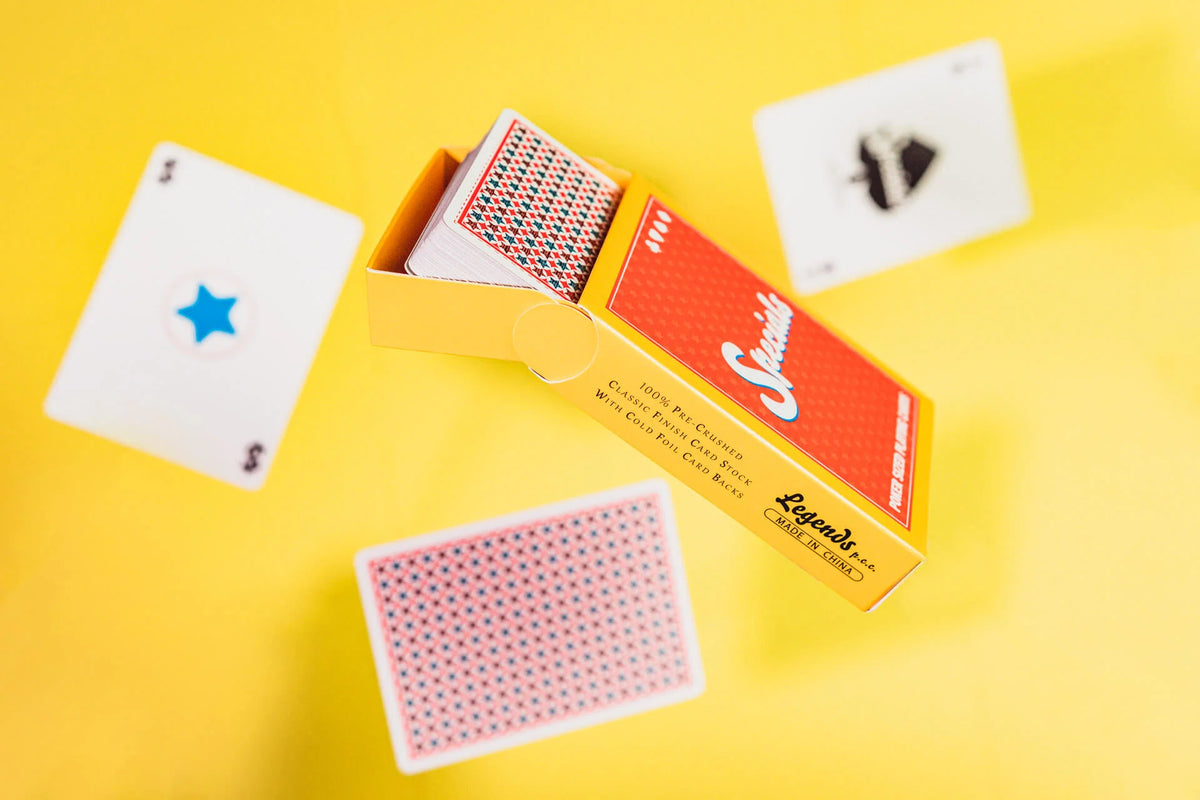
Budget-friendlyA sharp metal shape stamps out a window or an unusual outline on the box, so a card peeks through, or the box opens in a way nobody expects, like the hinged cigarillo box of our Specials deck.
Good to knowA window in the standard tuck shape is inexpensive. A completely new box shape needs its own cutting die, a one-time charge.


Part four
Boxes & packaging
The box is the first thing anyone sees, and it is where special features cost the least. We are paper experts: if it can be made from paper, we can make it.
-

Matte uncoated tuck box
Included in the base priceOur standard tuck box: the classic flip-top card box on an extra-thick matte, uncoated paper (similar feel to printer paper, but much thicker). It gives soft, slightly muted colors and a lovely natural, papery feel in the hand. Our tucks forgo the click-lock on the flap that you see on many standard decks, because it tears easily and looks worn after minor use.
Every box is cello-wrapped with a tear strip so it opens cleanly.
Good to knowPairs well with the shine of hot foiling, which contrasts well with the matte paper. A premium feel for very little extra cost.
-
Coated tuck box
Included in the base priceThe ink sits on the surface instead of soaking in, so colors come out brighter and more saturated and fine detail prints crisper. It is the right choice for bold, colorful artwork or photographs.
The surface is smoother and has a slight shine to it. Pantone Coated colors will match well with this tuck box paper.
Good to knowHot foil and spot UV both work well on coated paper, and a soft-touch or matte lamination can go on top if you want the color without the slight shine.
-
Specialty box papers
Budget-friendlyInstead of printing a color, start with a special paper: deep black, pearlescent, metallic silver, or a paper with a texture you can feel. Then add foil or embossing on top.
The box above is an embossed pearlescent paper. The shimmer is the paper itself.
Good to knowColored papers are great with foil and embossing, but printing colors on them is harder and they will be muted. Hot foils are opaque and typically used on colored paper stock. Plan the artwork around the paper first.
-
Printing inside the box
Budget-friendlyOpen the box and find more artwork inside: a pattern, a color, a message, a hidden joke. It is a small surprise that people remember.
Good to knowFull color, a single color, or even foil can go on the inside.
-

Luxury boxes
PremiumWhen the box is the gift. Leather or cloth-wrapped cases, magnetic closures, velvet or foam inserts that hold each deck snugly, ribbon pulls, and presentation cases for two, four or six decks.
These are made for hotels, brands and collectors' editions where the unboxing matters as much as the cards.
Good to knowEvery luxury box is built and sampled for your project, so allow extra time for tooling and a physical sample before production.
-
Rigid boxes
PremiumHard, thick boxes like a jewelry box: a lift-off lid, a sliding drawer, or a magnetic book-style box with a ribbon, like the one we made for Mad Fritz above.
Perfect for two-deck gift sets, tarot decks and luxury editions.
Good to knowWe can make a physical sample of a custom rigid box before production. They take up more room in shipping, so typically they will cost a bit more to ship.
-
Sleeves & bands
Budget-friendlyA paper sleeve that slides over the box, or a thin band wrapped around it, like the old-fashioned tax stamps on vintage decks. A nice way to add a second color, a special paper, or a limited-edition message without changing the box.
Good to knowBands and sleeves can be printed, foiled, or made from metallic paper.
-
Seals
Budget-friendlyThe little sticker that has to be broken to open the deck. Ours is printed with fine detail and perforated like a postage stamp, so it tears cleanly along the thumb cut instead of leaving a sticky mess.
Seals can be numbered (001/500) for limited editions, holographic, metallic, kraft, or cut in a custom shape.
Good to knowNumbered seals are printed in sequence from one artwork file, so just leave a space for the number. Numbers are printed in black Times New Roman.
-

Brick & display boxes
Budget-friendlyDecks are packed six or twelve to a printed "brick" box. Plain cartons are included; a printed brick looks great on a shop shelf or as a Kickstarter reward tier.
Good to knowSix-deck and twelve-deck bricks, plus half-brick and two-deck sets.


Part five
Inks & color
All of our decks are printed on a 50-tonne offset press, the same kind used for the best art books. Here is what we can put through it.
-

Full color (CMYK)
Included in the base priceFour inks (cyan, magenta, yellow and black) are printed as tiny dots that mix together to make every color in a photo or a painting. This is how most artwork is printed, on both the cards and the box.
Good to knowFull-color faces and backs are included in every quote. We proof your colors under standard daylight lamps so what you approve is what you get. If you want sharper and more saturated colors, choose up to 5 Pantone Coated colors for your cards.
-
Pantone spot colors
Mid-rangeNeed an exact brand color, a bright neon, or a perfectly flat solid color? Instead of mixing dots, we mix that one ink specially, so it comes out richer and more exact than CMYK can manage.
Classic one- and two-color card backs are printed this way.
Good to knowTypically 5 colors, but we can go up to 10 if your budget allows! Metallic and neon Pantones are available too.
-

Neon & black-light inks
Mid-rangeFluorescent inks that glow bright in daylight, and secret inks that only show up under a black (UV) light, in red, green or blue. Hide a message on the cards that only appears under the black lights of a party!
Good to knowPrinted as an extra Pantone color, so it can go on any card or on the box.
-

White ink & undercoats
Mid-rangePrinting on dark paper or on foil is tricky because the colors sink in or go see-through. So first we print a layer of white where you need it, and then your colors on top stay bright.
White can also be used to "block out" the shine of a foil exactly where you want plain paper, like the white border of a card.
Good to knowOn black or colored box paper, white hot foil gives a brighter, cleaner white than white ink, which will look gray.
-

Edge printing
Mid-rangeWant to print on the edge of your decks? It isn't common, but we have done this for customers adding that extra special touch to a deck. One customer made their custom decks into a puzzle that could only be solved with the cards in the correct order!
It is the small detail that can add amazing branding opportunities to your decks.
Good to knowCMYK full color digital printing. Be careful though, because a sharp eye may be able to tell each card apart from the others, effectively making a marked deck!
-

Mini decks
Mid-rangeA full 54-card deck shrunk down to fit in the palm of your hand, printed on the same press with the same inks and casino-grade paper as our full-size decks. Tiny cards, with every detail still crisp.
Great for gifts, travel decks, stocking fillers and collector sets. The Flea Circus deck we printed for Art of Play is a favorite example.
Good to knowFine lines and small text shrink with the cards, so we check your artwork for legibility at the smaller size. Mini decks get their own mini tuck box, with foil and embossing available.


Part six
Extras
-
Uncut sheets
Budget-friendlyA whole press sheet of your deck, before it is cut into cards: all 54 cards in one big poster-sized print. Collectors love them framed on the wall.
Good to knowPriced the same as a deck. They are big and can get knocked about in transit, so it is worth ordering a few spares.
-

Extra cards & special editions
Budget-friendlyA standard deck is 54 cards (52 plus two jokers). Add a 55th or 56th card for a gaff card, an info card, a double-backer, or an ad card. Or print one deck in two colorways to give collectors something to chase.
Good to knowExtra cards are cheap if they share colors with the rest of the deck. A second colorway keeps the same cards and just changes the box, or vice versa.
-

Matching sets
Mid-rangeTwo or more decks designed to go together: a light and a dark version, a two-deck gift set in one box, or a deck with a matching slim half-size deck.
Good to knowThe 1,000-deck minimum applies to each set of card artwork, but boxes can differ.


If you can dream it
Basically, any print or packaging technique in the world
The things above are what we do most often, but they are not the limit. We have also made decks with thermographic (heat-reacting) ink, flocked "furry" boxes, embroidered boxes, printed box edges, plastic (PVC) cards for casino use, leather cases, slim half-size decks, and plenty of ideas that started as an idea in an email.
Tell us the crazy idea and we will work with you to get it made.

A rough guide
What costs what
Every deck starts from the same base: your full-color cards, a printed tuck box, cello wrap and brick boxes. Special features are added on top, per deck. Here is roughly how they stack up, so you can plan before you ask for a quote.
- Budget-friendly
Hot foil on the box, soft-touch, metallic inks, printing inside the box, specialty box papers, custom seals, bands and sleeves, extra cards. Usually a few dozen cents per deck each.
- Mid-range
Hot foil on the cards, embossing, spot UV, Pantone colors, gilded edges, edge printing, mini decks, tarot and oversized cards, neon and black-light inks. Roughly one to three dollars per deck.
- Premium
Cold foil, full foil and holographic foil on the cards, laser cutting, rigid boxes, and luxury or custom packaging. These are the techniques that make a deck truly one of a kind, and they cost a few dollars per deck more.
There are no hidden charges: our prices for foil and embossing include the plates and tooling. Minimum order is 1,000 decks per design.
Ready when you are
Print your own deck with Legends
Send us your artwork or your idea, tell us which of the features above you like, and we will come back with a quotation and honest advice on what will look best.